A Chinese Traveler’s Reflection on Cultural Heritage and History
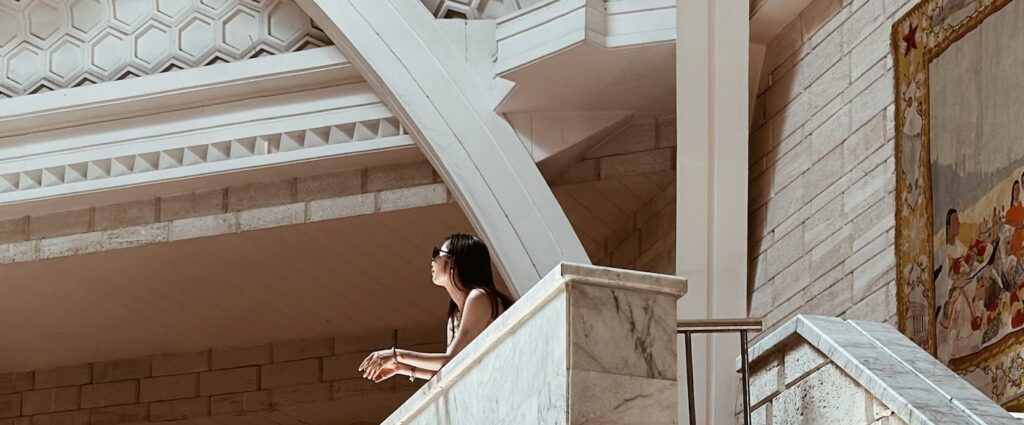
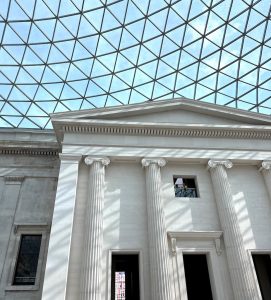
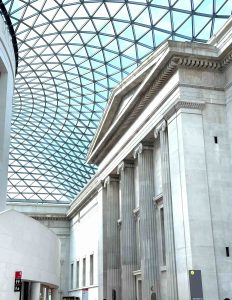
When I first stepped into the British Museum, what struck me wasn’t just awe — it was a wave of complex emotions.
All around me stood ancient relics from across the world — Egyptian deities, Chinese bronzes, Greek sculptures — each silently telling a story of how they were taken away from their homeland.
Growing up in China, I deeply understand the pain of cultural loss. The ashes of the Old Summer Palace (Yuanmingyuan) and the looted treasures of the Forbidden City are wounds etched in our collective memory.
And now, standing in front of these civilizations displayed in London, I felt both wonder and sorrow.
🏛️ The Legacy of the British Museum
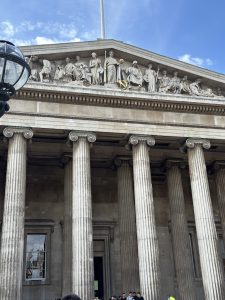
The British Museum, founded in 1759, was the world’s first national museum open to the public, built upon the private collection of Sir Hans Sloane.
Today, it holds more than 8 million artifacts, representing over 200 countries and civilizations, covering almost the entire span of human history — from prehistoric tools (2 million years ago) to modern art.
Among them are more than 23,000 Chinese relics, including Shang and Zhou bronzes, Tang dynasty figurines, and Ming-Qing ceramics.
Every time I walk into one of the world’s top ten museums, my emotions are indescribably mixed.
The memories of colonial plunder — from the Eight-Nation Alliance’s burning of the Yuanmingyuan to the looting of imperial treasures — remain vivid, echoing through generations of Chinese hearts.
Those once-glorious palaces and priceless artworks were turned to ashes or scattered across the world, displayed behind glass cases in foreign museums.
Each time I see a piece of Chinese art abroad, I feel an ache — a blend of familiarity and estrangement, pride and loss.
These artifacts embody 5,000 years of Chinese civilization, yet they now rest in silence, narrated in foreign languages.
🏺 The Dilemma of Civilization: Preservation or Plunder?
Later, driven by my fascination with human civilization, I visited Egypt.
There, beneath the blazing sun, I stood before temples and statues weathered by millennia.
And I couldn’t help but wonder — these relics, once sacred parts of their homeland, now rest in museums oceans away.
How many were chiseled from temple walls, packed in crates, and shipped across continents?
In the galleries of the British Museum, I could almost feel the lingering tremors of those moments of colonial looting.
Sometimes I find myself asking — do these artifacts miss home too?
Once revered and worshipped within their native cultures, they are now labeled as “world heritage.”
I believe in the beauty of cultural exchange and shared civilization, yet I can’t help but question —
Does “sharing” humanity’s legacy mean we ignore the pain of history?
🌐 Between Anger and Reflection
But beyond indignation lies another thought:
If Britain hadn’t taken these artifacts, what would have happened to them?
Would they have been destroyed by war, lost to chaos, or sold on the black market?
Perhaps, through these unjust acts, fragments of human history have survived — allowing us to see, learn, and reflect today.
This doesn’t justify the colonial plunder — it only reminds us how history is never simple.
No matter their origin or journey, these relics are evidence of human wisdom and creativity.
That is, perhaps, the ultimate mission of a museum —
“To preserve and share the achievements of human civilization with all humankind.”
🏛️ Top Must-See Exhibits at the British Museum
Visiting the British Museum is a journey through human history, spanning continents and millennia. Here are some must-see exhibits that capture the essence of global civilization:
1️⃣ Rosetta Stone 📖
Discovered in Egypt, the Rosetta Stone was the key to deciphering ancient Egyptian hieroglyphs, unlocking the secrets of one of the world’s oldest civilizations.
📍 Location: Egyptian Gallery, Room 4
2️⃣ Elgin Marbles 🏛️
Originating from the Parthenon in Athens, Greece, these exquisite marble sculptures depict Greek mythology and showcase the artistic peak of ancient Greece.
📍 Location: Greek Gallery, Room 18
3️⃣ Egyptian Mummies 🧭
From pharaohs to priests, the well-preserved Egyptian mummies demonstrate the sophisticated embalming techniques of ancient Egypt, offering a direct glimpse into millennia-old funerary practices.
📍 Location: Egyptian Galleries, Rooms 62-63
4️⃣ Assyrian Lion Hunt Reliefs 🦁
Dating back to the 7th century BC Assyrian Empire, these detailed reliefs portray the dramatic encounters between ancient kings and lions, reflecting the power and prestige of Mesopotamian rulers.
📍 Location: Middle East Gallery, Room 10
5️⃣ Sutton Hoo Treasure ⚔️
From the Anglo-Saxon ship burial in England, the Sutton Hoo treasure is often called “England’s Tutankhamun,” showcasing ceremonial helmets, weapons, and artifacts of royal status.
📍 Location: British History Gallery, Room 41
💡 Visitor Tips for the British Museum
Visiting the British Museum can be a full-day cultural experience, and a little planning goes a long way. Here are some practical tips for your trip:
-
Book Free Tickets in Advance: Reserve your entry tickets on the official British Museum website to avoid queues, especially if you plan to visit in the morning when it’s less crowded.
-
Download the Museum App or Rent an Audio Guide: Enhance your visit with detailed explanations of exhibits and galleries.
-
Photography: You are welcome to take photos, but flash photography is prohibited.
-
Gift Shop: The museum’s gift shop is exceptionally well-designed, featuring Rosetta Stone-themed souvenirs and a wide variety of cultural keepsakes.
🌙 Evening & Special Experiences
The British Museum is not only a daytime cultural landmark but also offers a unique nighttime charm. The museum regularly hosts:
-
Special Exhibitions
-
Lectures and Educational Talks
-
Interactive Art Workshops
-
“Late Night at the Museum” Experiences
These evening events often allow visitors to explore galleries in peaceful, dimly-lit settings, offering a rare opportunity to experience ancient civilizations at a slower, more reflective pace. Guided by volunteers or scholars, you can walk through galleries that are usually busy during the day and gain a deeper connection with history.
All special events and night visits can be booked in advance via the official British Museum website, making it a must-try experience for culture lovers visiting London.
China Pavilion
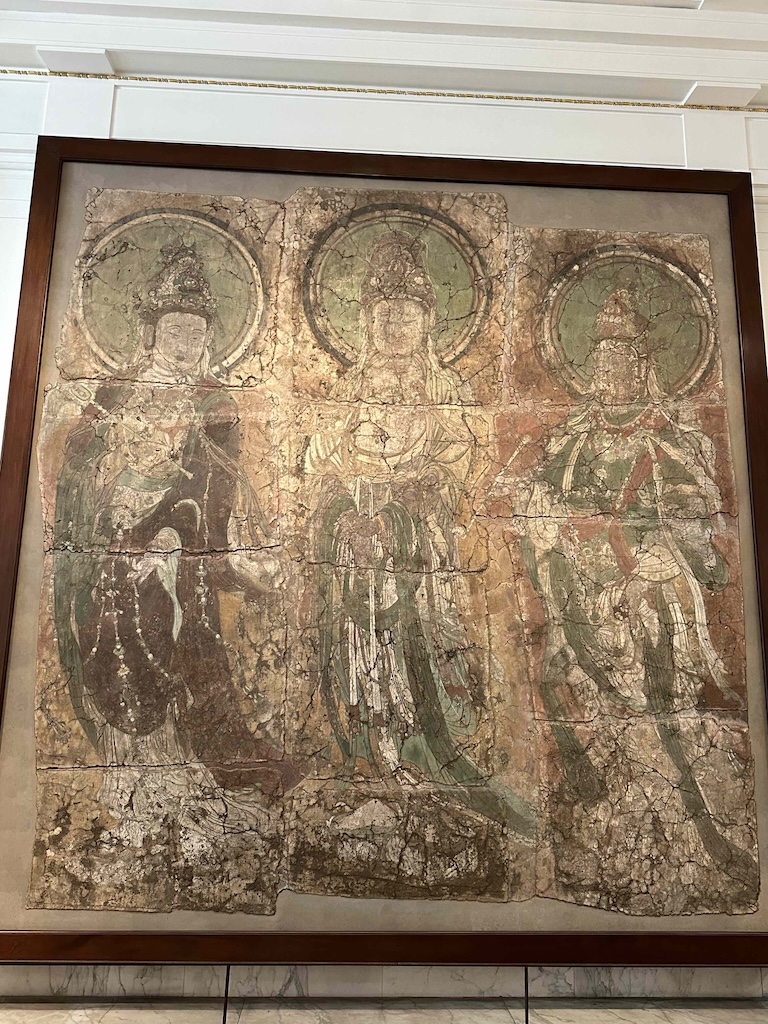
Qingliang Temple Wall Painting
Three Bodhisattvas (1424, Ming Dynasty)
🖌 Creation & Artistic Details
-
Date of Creation: Originally painted in 1424 (Ming Dynasty), with subsequent restorations or repaintings in 1437 and 1468.
-
Origin / Original Location: Qingliang Temple, Xingtai County, Hebei Province, China.
-
Material & Technique: Polychrome painting on plaster wall.
-
Dimensions: Height approx. 430 cm, Width approx. 454 cm (within wooden frame).
🎨 Subject & Iconography
The mural depicts three Bodhisattvas arranged with elegance and rhythm:
-
Center Bodhisattva – Avalokiteshvara (Guanyin):
-
The crown features a small image of Amitabha Buddha.
-
Represents compassion and mercy, central in Mahayana Buddhist art.
-
-
Left Bodhisattva – Samantabhadra (Puxian):
-
Holding a fly-whisk (traditional ritual object).
-
Crown adorned with the “Three Jewels”.
-
-
Right Bodhisattva – Manjushri (Wenshu):
-
Crowned with a miniature Buddha image.
-
Holding a ritual scepter or similar object symbolizing wisdom.
-
Visual Highlights:
-
All three Bodhisattvas have radiant halos.
-
Garments and drapery feature narrow, flowing folds (falling-pleat style) that convey rhythm and movement.
-
The Bodhisattvas are arranged in a subtle S-shaped or curved composition, creating balance and dynamic flow in the overall mural.
🏛 Historical Background & Removal
-
Qingliang Temple was a historically significant northern Chinese temple, founded in 1183.
-
By the early 20th century, the temple had fallen into disrepair.
-
The mural was divided into 12 sections and carefully removed from the supporting wall or wooden structure.
-
These sections were later acquired by collector George Eumorfopoulos and donated to the British Museum in 1927.
-
Prior to donation, the murals were mounted on wooden frames that supported their large-scale wall format within the remnants of Qingliang Temple.
-
According to an inscription dated 1485, the original mural was painted by monks from Mount Wutai, Shanxi, in 1424, with repairs in 1437 and 1468.
-
Qingliang Temple was destroyed during early 20th-century conflicts; the main temple no longer exists.
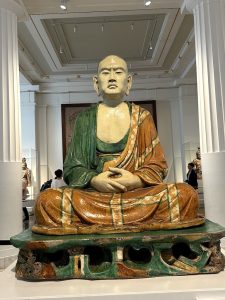
Gilded Jin Dynasty Arhats
Life-Size Sancai Stoneware Statues (1115–1234, Jin Dynasty)
🏺 Discovery & Origin
-
Year of Discovery: 1912
-
Location: Yizhou Caves, Yixian County, Hebei Province, China
-
Findings: A set of ten life-size Arhat statues, representing the disciples of Buddha, originally excavated from the Yixian caves.
-
Donor: Art Fund, 1913
🎨 Material & Technique
-
Material: Stoneware (ceramic) with sancai (three-color) glaze, typically in green, brown, and blue.
-
Firing Process:
-
Initial biscuit firing at approx. 980°C.
-
Glaze application with distinctive three-color leaded glaze, accenting eyes and lips with black and red.
-
Final firing at slightly lower temperature, possibly in Longquan kiln style.
-
-
Dimensions & Weight:
-
Height: approx. 103 cm
-
Total weight including base: approx. 120 kg (base alone: 106 kg)
-
🧘 Iconography & Artistic Features
-
Pose: Seated Arhats with hands resting on their laps.
-
Expression: Solemn and serene facial expressions, evoking meditative calm and spiritual contemplation.
-
Clothing & Drapery: Decorative stripes and borders on robes, emphasizing the humility and dignity of Buddhist practitioners.
-
Special Features:
-
Realistic modeling of faces, hands, and skin textures.
-
Each statue appears as an individual monk portrait, deeply immersed in compassion and meditative focus.
-
⏳ Historical Context
-
Dynasty: Jin Dynasty (1115–1234)
-
These statues exemplify the peak of Jin Dynasty ceramic sculpture, combining religious devotion with technical mastery in sancai glazes.
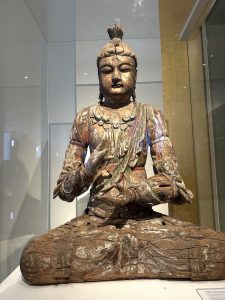
Painted Wooden Statue of Guanyin Bodhisattva
🏛 Historical Period & Origin
-
Dynasty: Late Song / Jin Dynasty (circa 1115–1234 CE)
-
Origin: Shanxi Province, China — a region renowned for its Buddhist art and temple sculptures.
🪵 Material & Craftsmanship
-
Material: Carved wood, coated with white gesso and mineral pigments.
-
Technique: The surface was originally brightly painted, though much of the pigment has faded over time due to natural aging.
-
Dimensions: Height approx. 141 cm (1.41 m)
🎨 Artistic Style & Iconography
This wooden Guanyin (Avalokiteshvara) Bodhisattva exudes grace and spiritual serenity.
-
The facial features are calm, introspective, and dignified, capturing the Bodhisattva’s compassionate nature.
-
The static yet powerful posture conveys inner strength and stillness — a hallmark of Northern Chinese Buddhist sculpture from the Song and Jin periods.
-
The drapery folds flow naturally across the body, showing the sculptor’s deep understanding of human anatomy and fabric movement.
-
The statue once wore a metal crown, now lost, which symbolized divine wisdom and the Bodhisattva’s enlightened status.
🕊 Cultural Significance
Wooden sculptures like this one represent the fusion of realism and spirituality in Chinese Buddhist art. They reflect both the artistic refinement and the religious devotion of the Song–Jin era craftsmen in Shanxi. Despite centuries of weathering, this Guanyin statue still radiates a profound sense of peace, compassion, and timeless beauty.
Egypt and Sudan Galleries
The Soul of Ancient Civilizations at the British Museum
The “Egypt and Sudan” Department of the British Museum houses one of the world’s most extensive and important collections of ancient Egyptian artifacts — second only to the Egyptian Museum in Cairo. It offers a breathtaking journey through over 11,000 years of history, from prehistoric Egypt (c. 11,000 BCE) to the Coptic Christian era, and captures the evolving cultures along the Nile Valley, including the rich intersection of Egypt and Sudan.
The department’s collection exceeds 110,000 artifacts from Egypt and Sudan, alongside more than 23,000 relics from China, making the British Museum a true “Museum of the World.”
Yet, for some nations, it also represents a “palace of stolen memories” — a reminder of how imperial powers once took away the tangible soul of ancient civilizations.
Just as the Chinese feel sorrow seeing relics from the Old Summer Palace (Yuanmingyuan) far from home, one can imagine the Egyptian pain when facing their pharaohs’ sarcophagi and sacred wall paintings displayed in London.
🏺 Highlights You Shouldn’t Miss
If your time is limited, focus on these must-see rooms within the Egypt & Sudan section:
1️⃣ Room 4 – Egyptian Sculpture Gallery
See monumental statues, including the Rosetta Stone, the key to decoding hieroglyphs.
2️⃣ Room 61 – The Tomb of Nebamun
The vivid wall paintings from Nebamun’s tomb (c. 1350 BCE) capture scenes of daily life along the Nile.
3️⃣ Rooms 62–63 – The Mummies Gallery
Discover the secrets of Egyptian mummification, from pharaohs to priests, and the spiritual beliefs behind their afterlife rituals.
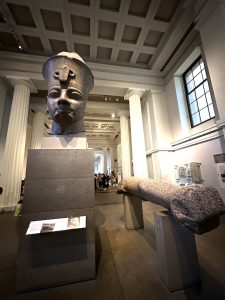
Amenhotep III – The Pharaoh of Egypt’s Golden Age
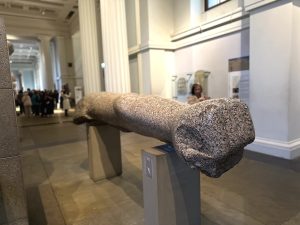
One of the most awe-inspiring pieces in the Egyptian Sculpture Gallery (Room 4) of the British Museum is the colossal red granite head and right arm of Pharaoh Amenhotep III, dating back to around 1390–1352 BCE (18th Dynasty). Originally part of a monumental seated statue from Thebes (modern-day Luxor) in Upper Egypt or northern Sudan, this sculpture still commands an extraordinary presence — even as a fragment, it rises several meters tall.
🏺 Material and Symbolism
Carved from red granite quarried in Aswan, a stone symbolizing strength and eternity, the statue captures both the divine and human essence of pharaonic power. Amenhotep III wears the Nemes headdress, the traditional royal crown, his calm yet commanding face reflecting the refined artistry of Egypt’s 18th Dynasty. In his hands, the pharaoh once held a papyrus document — a symbol of wisdom and governance. This statue, along with its slightly smaller twin, originally stood at the entrance of the Temple of Mut at Karnak, dedicated to the consort of the god Amun-Ra.
🏛 A Legacy of Majesty and Art
Amenhotep III ruled for about 38 years, presiding over one of Egypt’s most prosperous and artistically accomplished eras — often called the “Golden Age of Ancient Egypt.”
He was the grandfather of Tutankhamun, and during his reign, Egypt’s empire stretched across vast territories through diplomacy and trade. Art and architecture flourished, with an emphasis on idealized beauty and divine kingship.
Among the grand monuments he commissioned were the Temple of Luxor and the famous Colossi of Memnon, which still stand majestically on the west bank of the Nile. Most of the largest statues in this gallery were also created under his order — a testament to his vision of eternal power and divine legacy.
🌍 The Story Behind the Stone
Standing before this colossal head in London, it’s difficult not to feel a deep sense of awe — and conflict. I once walked among the ruins of Luxor, beneath the blazing Egyptian sun, where shattered columns and half-buried statues whispered stories of ancient glory. Never did I imagine that, thousands of kilometers away, I would encounter the same pharaoh’s image preserved in the British Museum, resting silently behind glass.
Yet as I gazed upon it again, a wave of emotion rose within me. I couldn’t help but wonder — what if these statues could return to their homeland? To once again stand under the sunlight of the Nile Valley, amid the chants of priests and the scent of desert wind. They belong not to the stillness of display cases, but to the rhythm of their land — to breathe once more with Egypt’s dust, light, and spirit.
🕊️ The Mark of Ramses II
Interestingly, this statue was originally made in Amenhotep III’s likeness, but nearly a century later, Pharaoh Ramses II ordered the facial features to be re-carved to resemble his own. Ramses was known for his habit of claiming earlier monuments as his own, altering inscriptions and features to immortalize his rule.
While statue appropriation was common in Egyptian history, only Ramses II so boldly reshaped the faces of kings before him — rewriting stone, and with it, history itself.
itself.
Jebel Sahaba: One of the Earliest Known Sites of Prehistoric Warfare
Jebel Sahaba is an archaeological site located along the Nile River in northern Sudan, near the Second Cataract on the modern Egypt–Sudan border. Dating back roughly 13,000–14,000 years to the Late Palaeolithic period, it is part of the wider Nubian Archaeological Zone, a region crucial for understanding the early history of the Nile Valley.
The site was discovered in the 1960s during a major rescue excavation ahead of the Aswan High Dam construction. The project was led by renowned archaeologist Fred Wendorf and his international research team. Originally labeled Site 117, it later became known as the Jebel Sahaba Cemetery.
Evidence of Prehistoric Violence: 59 Human Skeletons with Trauma
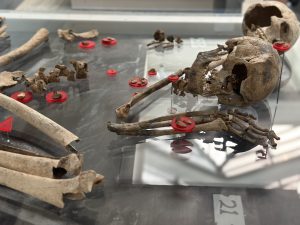
Archaeologists uncovered around 59 human skeletons, many of which show unmistakable signs of violent conflict. These findings are a major reason why Jebel Sahaba is often described as one of the earliest documented battlefields in human history:
-
Multiple skeletons contain stone arrowheads, spear points, or projectile tips still embedded in their bones
-
Many individuals show stab marks, cut marks, and blunt-force injuries, indicating death during intense combat
-
Some skeletons show healed wounds, suggesting repeated episodes of violence rather than a single attack
Together, these discoveries indicate that organized violence and long-term conflict existed among Late Palaeolithic groups in the Nile Valley.
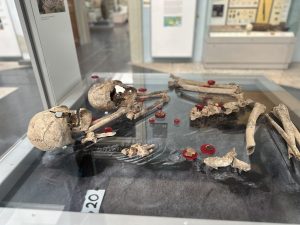
Why the Jebel Sahaba Site Matters: Climate Stress and Early Human Conflict
The Jebel Sahaba findings are significant for anthropology and archaeology because they reveal:
1. Early Warfare Triggered by Climate Change and Resource Competition
As the Ice Age ended and environmental conditions shifted, food and water became scarce. Human groups likely fought over territory, water sources, and survival resources.
2. The Victims Were Early Nubian Populations
Skeletal analysis shows the individuals belonged to Nubian cultural groups, some of the earliest known settlers in the Nile Valley. Their remains provide rare insight into the origins of Nile Valley societies.
Some scholars interpret the cemetery as evidence of conflict between distinct populations, while others view it as a direct consequence of climate-induced survival stress.
3. Evidence of Intergroup Conflict or Survival-Driven Aggression
Some scholars interpret the cemetery as evidence of conflict between distinct populations, while others view it as a direct consequence of climate-induced survival stress.
In either case, Jebel Sahaba stands as a landmark discovery for understanding the origins of warfare, human conflict, and adaptation during the Late Palaeolithic.
Canopic Jars — Essential Funerary Artifacts in Ancient Egypt
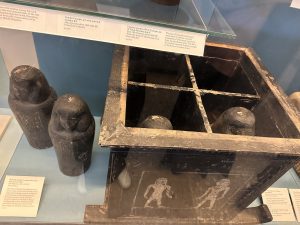
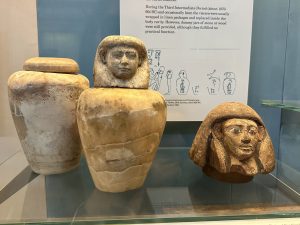
Canopic jars were among the most iconic funerary vessels in Ancient Egyptian civilization, playing a vital role in the mummification process. During embalming, the deceased’s internal organs—including the liver, lungs, stomach, and intestines—were removed to prevent decay. These organs were then carefully preserved and stored inside sets of Canopic jars, each protected by a specific deity.
In Egyptian belief, bodily integrity was essential for the soul’s eternal life. Although organs needed to be removed for preservation, they still had to be safeguarded so that the deceased could be made whole again in the afterlife.
Each jar was topped with a lid carved in the form of a protective deity known as “The Four Sons of Horus”, with each god responsible for guarding a specific organ:
-
Imsety — human-headed; guardian of the liver; protected by the goddess Isis.
-
Hapy — baboon-headed; guardian of the lungs; protected by Nephthys.
-
Duamutef — jackal-headed; guardian of the stomach; protected by the goddess Neith.
-
Qebehsenuef — falcon-headed; guardian of the intestines; protected by Serqet.
Canopic jars were typically crafted from limestone, alabaster, terracotta, or wood, and often decorated with hieroglyphic inscriptions and protective prayers. They were placed beside the coffin or inside a dedicated Canopic chest within the burial chamber.
The British Museum houses several remarkable sets of Canopic jars, including examples from elite tombs of the New Kingdom period (c. 1550–1070 BCE). These artifacts offer profound insight into Ancient Egyptian religious beliefs, funerary rituals, and masterful craftsmanship.
Painted Wooden Figure of the Goddess Kali — Detailed Description & Historical Context
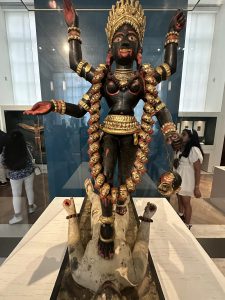
Title: Painted Wooden Kali Figure
Date: Late 19th century
Region of Production: Traditionally attributed to Krishnanagar, Bengal, India
Provenance: West Bengal region
Material / Technique: Painted and gilded clay (polychrome and gilt clay sculpture)
Dimensions: approx. H 53 cm × W 29 cm × D 43 cm
Acquisition: Likely created before 1894; entered the British Museum collection in 1894
Kali in Bengali Ritual Art
Clay sculptures of Kali have long been central to Kali Puja, an annual festival celebrated throughout Bengal to honor the goddess’s fierce yet compassionate nature. This painted and gilded clay figure represents a traditional devotional object used during ritual worship.
In Tantric and Shakta traditions, Kali is revered as a protective mother, a divine force who destroys ignorance and guides devotees toward spiritual liberation. She holds a severed human head, symbolizing the destruction of the ego. Her dramatic posture—standing atop her husband Shiva—expresses the supremacy of feminine creative energy and the cycle of power, destruction, and rebirth.
Iconography & Symbolism
This sculpture contains several hallmark features of Bengali Kali imagery:
- Bengali-style crown (traditional regional headgear)
- A necklace of skulls, representing time, impermanence, and transcendence
- Severed heads and ritual weapons held in her hands
- Earrings shaped like children’s bodies, a shocking yet meaningful motif symbolizing her unrestrained dominion over life and death, as well as the dissolution of worldly fear
In its original cultural setting, this type of sculpture was not merely decorative—it was an active ritual object used in worship, offerings, and festival ceremonies.
Colonial and Postcolonial Interpretations
Within the museum context, the figure is also used to illustrate themes such as female divinity, cosmic destruction, salvation, and the shifting interpretations of Indian religious art during the colonial and postcolonial periods.
The figure’s early collectors were likely colonial administrators or Christian missionaries. To many British writers of the era, Kali embodied what they perceived as the “savage” or “dangerous” aspects of Indian religion—an image they believed needed to be restrained or “civilized.”
However, Bengali revolutionaries later reclaimed Kali as a symbol of anti-colonial resistance, using the goddess to invert and subvert imperial narratives. Her fierce energy became a powerful emblem of strength, liberation, and national identity.
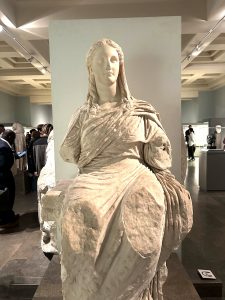
Marble Statue of Demeter
Date: 350–330 BC
Origin: Discovered at the Sanctuary of Demeter in Knidos, Greece
Material: Marble
This statue depicts Demeter seated upon a throne. The forearms and hands are missing; at least one of them may originally have held a libation bowl or torch. The head was carved separately from the body. Demeter is portrayed as the ideal Greek woman—serene, mature, and compassionate—wearing a modest veil. A now-missing figure of her daughter Persephone may once have stood beside her.
As one of the most iconic representations of Demeter in ancient Greek art, this sculpture embodies the goddess’s role as the deity of agriculture, grain, and the fertility of the earth. She represents maternal care and the cyclical nature of life and harvest. Demeter governs the growth of crops, the rhythm of the seasons, and the sustenance of human civilization.
The statue is carved from fine Parian marble, known for its pure, luminous quality. Demeter is dressed in a traditional chiton and himation, with flowing folds that showcase the sculptor’s mastery of fabric, texture, and movement. Her expression is gentle and contemplative, marked by a subtle sadness—an echo of her grief and longing after the loss of her daughter Persephone.
Historical Background
Demeter’s myth is closely connected to the ancient Greek explanation of the seasons.
When Hades, brother of Zeus, abducted Persephone to the Underworld, Demeter’s sorrow caused the earth to wither and cease producing crops. Only after Zeus intervened was a compromise reached: Persephone would spend one-third of each year in the Underworld and the remaining months with her mother. This divine cycle became the mythological foundation for the changing seasons.
Demeter therefore embodies not only growth and abundance, but also loss, maternal devotion, and the eternal rhythm of death and renewal in nature.
Artistic Significance
This statue belongs to the late Classical period of Greek sculpture, a transitional era bridging the monumental style of Phidias with the softer, more naturalistic tendencies of Praxiteles.
-
The face is softly rounded, reflecting ideals of balanced and harmonious human beauty.
-
Her posture is poised and contemplative, combining religious solemnity with emotional depth.
-
The carving is exceptionally refined, especially in the drapery’s delicate lines and shifting light—a hallmark of mature Classical craftsmanship.
Cultural Importance
Demeter held a central place in ancient Greek religion. Her most important cult center, the Eleusinian Mysteries, was one of the most influential religious rites in antiquity, associated with spiritual renewal and the promise of life after death.
Today, this statue stands in the British Museum’s Greek and Roman galleries, displayed alongside marble sculptures from the Parthenon. It remains a vital artifact for understanding ancient Greek art, theology, and the cultural symbolism of motherhood, nature, and rebirth.